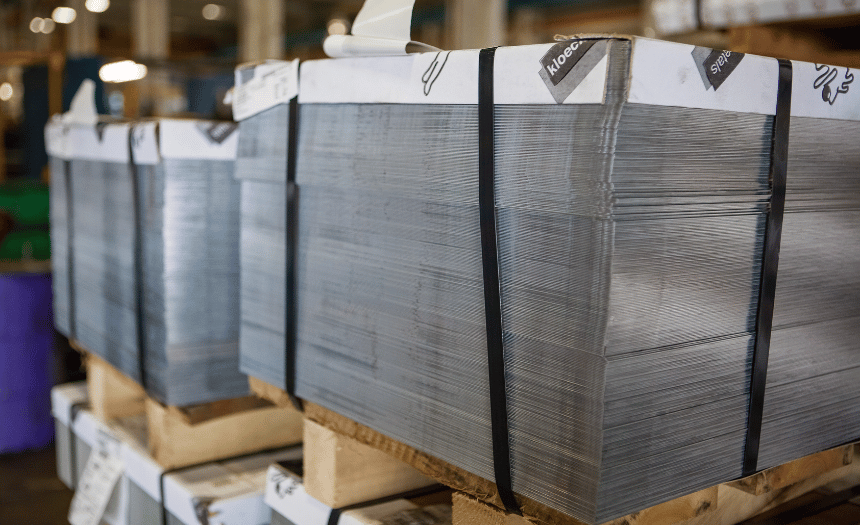
Established in 2002 and acquired by Kloeckner Metals Corporation in 2024, Amerinox Processing has grown into a leading provider of processing services for stainless steel, aluminum, red metals, titanium, and select coated carbon steels.
Operating out of a 325,000-square-foot facility in Camden, NJ, the company is strategically located just minutes from major highways, rail lines, and waterways.
Amerinox offers an unmatched range of processing capabilities under one roof. These include cutting-to-length services for hot-rolled materials from .125″ to .500″ thick and up to 80″ wide, as well as cold-rolled materials ranging from .014″ to .135″ thick and up to 72″ wide with various finishes. The company also provides coil polishing for materials .018″ to .135″ thick and up to 63″ wide, along with sheet and plate polishing for thicknesses ranging from .035″ to 6″.
With a team boasting over a century of combined expertise in the metals industry, Amerinox is committed to meeting your critical demands with precision, on-time delivery, and outstanding customer service.


Kloeckner Metals offers high-quality metal polishing, polished...
Answer:
Polishing and wet polishing are both surface finishing techniques, but they differ primarily in the process and materials used. Here’s a breakdown of the key differences:
| Aspect | Polishing | Wet Polishing |
|---|---|---|
| Use of Water | Optional | Essential |
| Dust Control | Minimal or none | Significant (water traps dust) |
| Heat Management | Potential overheating | Reduces heat generation |
| Surface Types | General | Ideal for stone, glass, or concrete |
| Durability | May wear equipment faster | Prolongs tool life |
In summary, wet polishing is a more specialized form of polishing designed to improve efficiency, safety, and results, particularly for certain materials like stone and concrete. Polishing, as a general term, includes both dry and wet methods, depending on the application and requirements.
Answer:
A #8 mirror line refers to a specific type of polished finish on stainless steel. Here’s what it means:
This type of finish is used in decorative applications where aesthetics are important, such as in architecture, elevators, high-end appliances, and luxury interiors.
What is the difference between wet and dry polishing?
Answer:
Polishing and wet polishing are both surface finishing techniques, but they differ primarily in the process and materials used. Here’s a breakdown of the key differences:
| Aspect | Polishing | Wet Polishing |
|---|---|---|
| Use of Water | Optional | Essential |
| Dust Control | Minimal or none | Significant (water traps dust) |
| Heat Management | Potential overheating | Reduces heat generation |
| Surface Types | General | Ideal for stone, glass, or concrete |
| Durability | May wear equipment faster | Prolongs tool life |
In summary, wet polishing is a more specialized form of polishing designed to improve efficiency, safety, and results, particularly for certain materials like stone and concrete. Polishing, as a general term, includes both dry and wet methods, depending on the application and requirements.
What is a #8 mirror line?
Answer:
A #8 mirror line refers to a specific type of polished finish on stainless steel. Here’s what it means:
This type of finish is used in decorative applications where aesthetics are important, such as in architecture, elevators, high-end appliances, and luxury interiors.

X
The Kloeckner Metals website uses modern technologies. Unfortunately, your browser doesn't support those technologies.
Download the latest version of one of these browsers to experience the site: