
An A36 steel plate is a mild, low-carbon steel typically used in construction and structural applications such as bridges and building construction. It is also prevalent in industrial manufacturing, particularly heavy equipment and machinery.
Due to its mechanical properties and adaptability, A36 steel remains a top material for projects requiring durability and cost efficiency.
Stay informed on stainless steel and aluminum market conditions with our monthly Specialty Metals Market Report. Each edition covers pricing trends, surcharges, freight costs, and key supply‑chain developments impacting delivered costs.
A36 steel is a standard structural steel that can be welded, punched, drilled, tapped, or machined.
High value and versatile, A36 is widely used in various industries, from construction to automobile manufacturing. This steel plate is known for its high strength, formability, and weldability. It’s also an excellent magnetic field conductor. Together, these benefits make A36 one of the most-used grades of carbon steel.
The American Society for Testing and Materials (ASTM) designated it A36. The “A’ stands for ferrous material, and the “36” is added because the steel’s yield strength is 36,000 PSI.

All steel is composed of iron and carbon, usually with a smattering of other elements added to the alloy. A steel grade’s exact chemical composition helps determine its strength, elasticity, and weight-bearing capacity and plays a crucial role in its mechanical performance.
Like other steel grades, A36 steel contains primarily iron but also includes small amounts of other elements that give it specific mechanical properties. The typical chemical composition includes:
Carbon content directly affects steel’s hardness and strength. A low-carbon steel, sometimes called “mild steel,” like A36, is weaker than steel grades with a higher carbon content. While “weaker” doesn’t sound like a positive adjective when talking about structural metals, it means that low-carbon steels are easier to weld, bend, punch, or machine — all qualities you want in a good construction material.
Manganese and silicon improve steel’s toughness and wear resistance. They are both deoxidizers, which means they remove oxygen from a chemical process. You want that in steel because it helps prevent defects and decay.
Phosphorus and sulfur, present in small amounts in A36, are often considered impurities but are controlled to maintain steel’s performance during manufacturing and usage. Phosphorus can make steel easier to weld, and sulfur makes it simpler to cut and shape.
ASTM uses a particular logic in grading steel. While you might think of a high grade as “better” and a low grade as “worse,” that isn’t how the process works. The organization assigns a series of letters, numbers, and sometimes dashes, each of which indicates something about the metal itself. “Grades” are not like what you remember from school; they’re just indicators.
“A” is for ferrous or iron-related material, so when you see a metal grade beginning with “A,” you know it contains iron. You don’t know how much carbon it contains, if it’s stainless or an alloy — just that it’s primarily iron. The rest of the designation is intended to help answer additional questions.
In this case, the ASTM A36 standard specifies the mechanical properties of A36 steel and its chemical composition. This designation ensures that the steel meets the necessary criteria for structural applications, providing a benchmark for manufacturers and engineers. ASTM A36 applies to various shapes and sizes, including steel plates, bars, and beams.
Yes, A36 steel is classified as a type of mild steel. Mild steel refers to carbon steels with a relatively low carbon content, usually between 0.05% and 0.25%. These steels are more affordable, more weldable, and more corrosion-resistant than carbon steels but also about 20% weaker. Since they are malleable and easier to work with, mild steels are often chosen over high-carbon steels.
A36 fits this classification due to its low carbon content of around 0.25%. However, it stands out from other mild steels due to its balanced mechanical properties, making it a top choice for structural applications that require flexibility and malleability.
ASTM is not the only organization that sets standards related to steel composition. Other associations around the world use different letters, numbers, and nomenclature to refer to the same kind of steel. Although this may seem confusing, it’s just how the evolution of steel has proceeded. Think about how some countries use metric measurements while others use the imperial system. It’s the same principle.
A36 steel meets several certifications and industry standards, including:
Meeting these certifications ensures that A36 steel is suitable for its intended applications, offering consistency and reliability in performance.
A36 steel has equivalents in other countries and standards. For instance, Europe’s closest equivalent is S235JRG2; in Japan, it’s SS400. Canada uses the designation 260W, and India labels it E250. These grades share similar mechanical properties, though there may be slight variations based on regional standards.
While ASTM A36 and ASME SA36 are often used interchangeably, they have subtle differences. ASTM A36 is the standard designation for structural carbon steel used mainly in construction and infrastructure. ASME SA36, on the other hand, is a designation used for steel intended for boilers and pressure vessels.
The core difference lies in the intended application: ASTM A36 is designed for structural purposes, while ASME SA36 is designed to withstand the stresses of high-pressure environments.
A36 steel and 1018 steel are similar but not identical. While both are low-carbon steels, 1018 steel has a slightly lower carbon content of about 0.18%, which makes it easier to machine.
Both steel types can be hot-rolled or cold-drawn and can be formed into different shapes. Typically, however, A36 is hot rolled and fashioned into steel plates, whereas 1018 is cold drawn and made into bars.
Because cold-drawn steel requires much more labor to produce, 1018 is generally more expensive than A36. It’s also stronger and has a better finish. A36 is more affordable and easier to form and weld, making it better suited for large structural applications, while 1018 is often chosen for applications requiring precise machining—think of things like shafts, spindles, and rods.
A36 steel is incredibly popular because it is affordable, versatile, and adaptable, making it useful in both construction and manufacturing.
Engineers and fabricators appreciate its balance of strength and flexibility and its ease of fabrication through methods such as welding, bolting, and riveting. A36 steel’s widespread availability and mechanical and physical properties make it a top choice for a wide range of projects.
A36 steel offers numerous benefits:
A36 steel’s mechanical properties make it suitable for various applications, especially structural work. Some of the critical mechanical properties include:
A36 steel features a density of 7.85 g/cm³ (7850 kg/m³), which is typical for carbon steel. This density makes the A36 strong yet lightweight enough for various structural applications. Its hardness measures 67-83 Rockwell and has a cutting speed of 120 feet per minute. A36 steel’s melting point falls between 2,590–2,670°F, and its thermal conductivity is 348 Btu-in/hr-ft2 F.
Calculating the weight of an A36 steel plate is a straightforward process that involves using the plate’s dimensions and density. You can use the formula:
Weight = Length × Width × Thickness × Density
For more details on calculating steel plate weight, refer to this guide on how to calculate the weight of a steel plate.
A36 plate is produced through a hot rolling process. Steel slabs are heated to a high temperature, typically above 1,700°F (926°C), to make the material more malleable. These slabs are passed through rollers that compress the steel to the desired thickness. After rolling, the plate is allowed to cool at room temperature.
The cooling process ensures the steel maintains its structure and mechanical properties. Additional processes like cutting, drilling, or surface treatments like shot blasting may be applied for specific applications. The finished A36 plate undergoes quality control checks to meet ASTM A36 standards for strength and composition.
It is utilized in numerous industries, including:

A36 steel can be joined through multiple methods.
Due to its low carbon content, A36 steel is highly weldable. It can be welded using various techniques, including arc welding, with minimal risk of cracking, making it ideal for construction.
Bolting is a common method for joining A36 steel, providing strong, reliable connections in structural applications. Bolted joints are easy to assemble and disassemble, and they are often used in steel-framed buildings and bridges.
Riveting is a traditional method for joining A36 steel, typically used in older or historical construction. Rivets provide strong, permanent connections, though they are primarily replaced by bolting and welding in modern structures.
A36 steel has a machineability rating of 72%, making it easy to cut, drill, tap, or shot blast. Before being used, A36 steel plate undergoes various processes, including:
A36 steel is available in multiple forms, not just plates. Other forms include:
Its’ unique properties, affordability, and versatility make it one of the most widely used structural steels. From wind turbine base plates to structural building frameworks, A36 steel remains a material of choice in industries that demand strength and reliability at an economical cost.
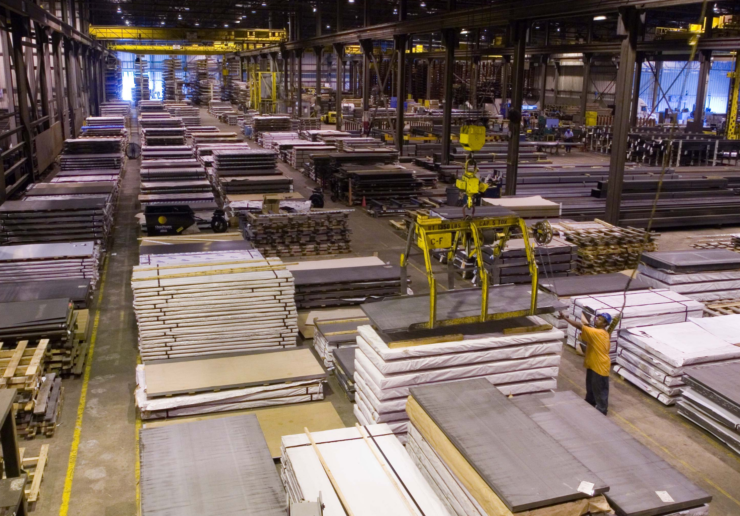
In the market for steel for base plates? Kloeckner Metals is a full-line steel supplier and service center. We combine a national footprint with the latest fabrication and processing technologies and the most innovative customer service solutions.

While some careers start with a clear plan, others take...
Düsseldorf (Germany), June 3, 2026, 1:18 pm CEST – Worthington...
Andrew Ureña, Kloeckner’s Vice President of Financial Reporting and Tax,...

X
The Kloeckner Metals website uses modern technologies. Unfortunately, your browser doesn't support those technologies.
Download the latest version of one of these browsers to experience the site:


