
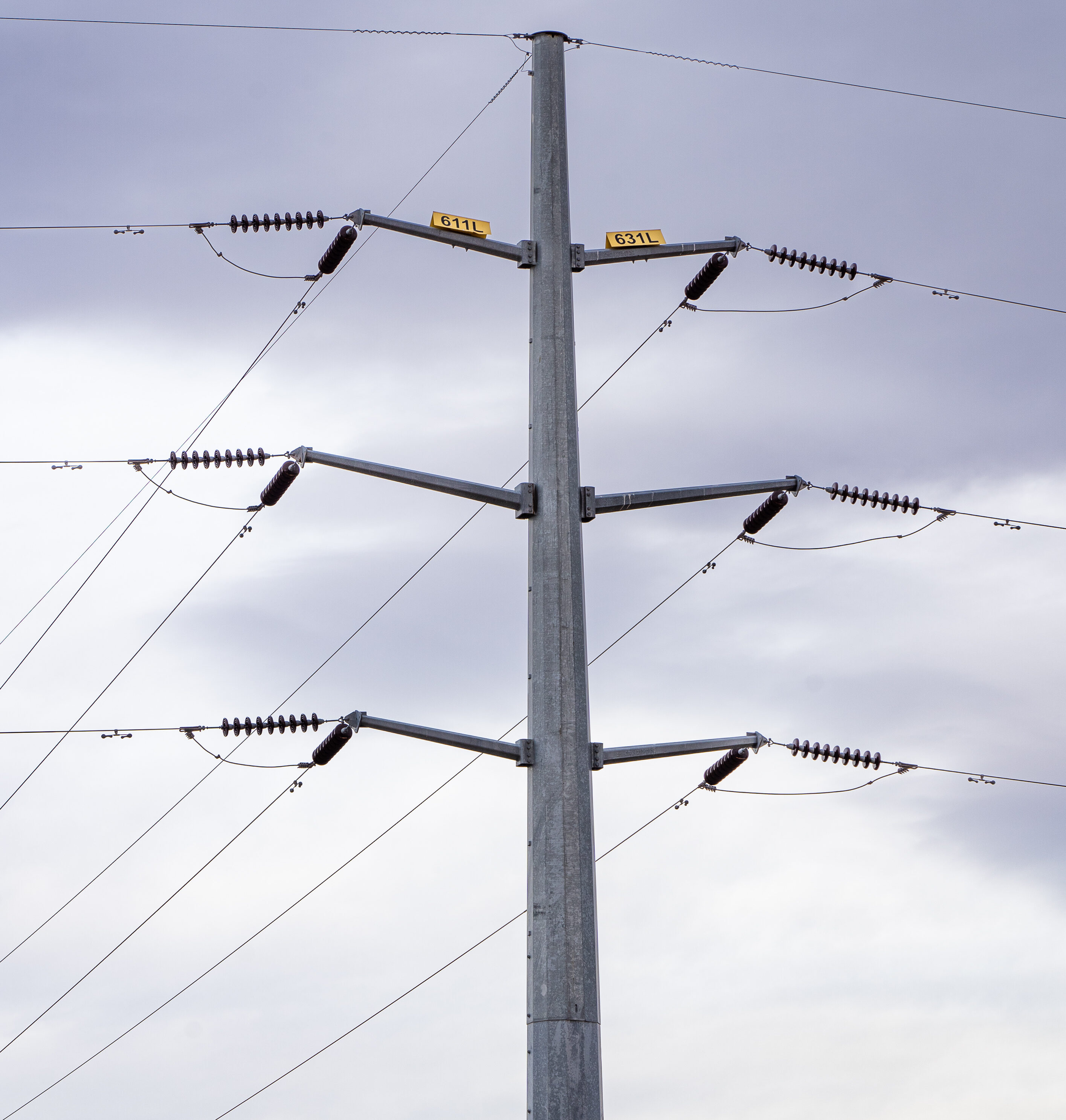
Less than 200 years ago, workers erected the first utility pole, which was designed to hold up telegraph wires. Today, more than 180 million utility poles dot the American landscape, supporting lines carrying electricity, telephone cables, fiber optic internet, and even street lighting. They’re so common, they almost disappear into the background. But these tall, unassuming structures are critical to modern life.
In this article, we’ll break down what utility poles are, what kinds exist, why steel is gaining ground in the industry, and how Kloeckner Metals supplies the steel materials that pole manufacturers rely on for this vital infrastructure.
Kloeckner Metals is a full-line steel supplier and service center. Download our structural plate spec sheet to see in greater detail what Kloeckner Metals routinely stocks.
A utility pole is a vertical structure that supports overhead public utility lines. Traditionally made from wood, utility poles are increasingly being built out of steel. Each year, America replaces approximately two million wooden poles, many of which are swapped out for steel due to the metal’s durability, efficiency, and ability to withstand extreme weather conditions.
If you’ve ever experienced a power outage after a storm, you already know how crucial these poles are. A single downed pole can knock out service to an entire block or neighborhood. When Hurricane Helene hit the Carolinas and Georgia in late 2024, it damaged six poles in the South Carolina Upstate alone, leaving nearly five million people without power. That’s why material selection matters.
Not all poles serve the same purpose. Utility poles are generally categorized by function or material. Some of the most common types of poles include:
Each type comes with different height, strength, and load-bearing abilities, so different types of poles may work best for different purposes.
The terms are often used interchangeably, with a subtle distinction.
A utility pole is a broad category that encompasses any pole used to carry services such as electricity, phone, or cable. A power pole, on the other hand, refers specifically to poles that support electrical transmission or distribution.
So while every power pole is a utility pole, not every utility pole is a power pole.
Responsibility depends on the location and type of service. Electric utilities typically own and maintain power poles. Municipalities might own lighting poles. Telecommunications companies may install their own poles or lease space on existing ones.
In many urban and suburban areas, multiple entities that work in conjunction with one another often own the poles. For example, you might see electric, internet, and cable lines stacked on the same structure. While shared use can complicate repairs, it’s more efficient than installing a separate pole for each service.
Steel utility poles are quickly gaining traction as a modern alternative to traditional wood poles. Why the shift?
Durability and consistency may be the primary reasons for replacing power transmission poles. Unlike wood, which varies in strength, steel poles provide uniform structural performance, and they aren’t susceptible to rot, cracking, or insect damage. Furthermore, steel is recyclable and can contain a high percentage of recycled content.
Steel is also safer than wood. It’s non-combustible, which is an essential feature in wildfire-prone regions, and it’s far less likely to snap, regardless of how powerful the wind shear or fierce the lightning storm.
Finally, steel is much more sustainable than wood. As the demand for utility poles increases, especially for broadband and renewable energy infrastructure, steel helps fill the gap left by declining timber resources. Plus, steel’s longevity and low maintenance profile often make it more cost-effective over time, even if the upfront costs are higher.
Steel utility poles can last 60 years or more with minimal maintenance, especially when they’re hot-dip galvanized for corrosion resistance. Compare that to the 30-40-year average lifespan of a wood pole, which may require treatment, regular inspections, and more frequent replacements.
In coastal or high-salinity areas, specialized coatings or weathering steel options can further extend the pole’s life.
Steel poles are showing up across a wide range of settings. Rural areas need steel’s height and strength for long transmission spans. Urban and suburban neighborhoods, where aesthetics, space constraints, and zoning regulations come into play, are seeing an increase in the number of steel poles.
They are also popular in disaster-prone regions, such as California and the Gulf Coast, where fire and hurricane resistance are essential. Finally, renewable energy projects, such as wind farms and solar installations, need strong, reliable transmission structures and so rely on steel poles.
Typically, A572 steel plates are used to create steel utility poles. This low-alloy, high-strength steel features a strength-to-weight ratio high enough to support power lines in all kinds of weather while facilitating transportation and installation. Galvanized steel is corrosion-resistant, which helps reduce long-term maintenance costs.
Material quality and processing precision matter. That’s where a trusted supplier comes in.
At Kloeckner Metals, we supply steel plates and long products tailored to meet the demands of power transmission, telecommunications, and infrastructure projects.
With nationwide inventory and in-house processing, Kloeckner delivers high-quality steel across North America. Your projects power progress; we supply the steel that makes it possible.
Kloeckner Metals is a full-line steel supplier and service center. We combine a national footprint with the latest fabrication and processing technologies and the most innovative customer service solutions.

Tube laser cutting is a manufacturing process used to cut...
While some careers start with a clear plan, others take...
Düsseldorf (Germany), June 3, 2026, 1:18 pm CEST – Worthington...

X
The Kloeckner Metals website uses modern technologies. Unfortunately, your browser doesn't support those technologies.
Download the latest version of one of these browsers to experience the site:


